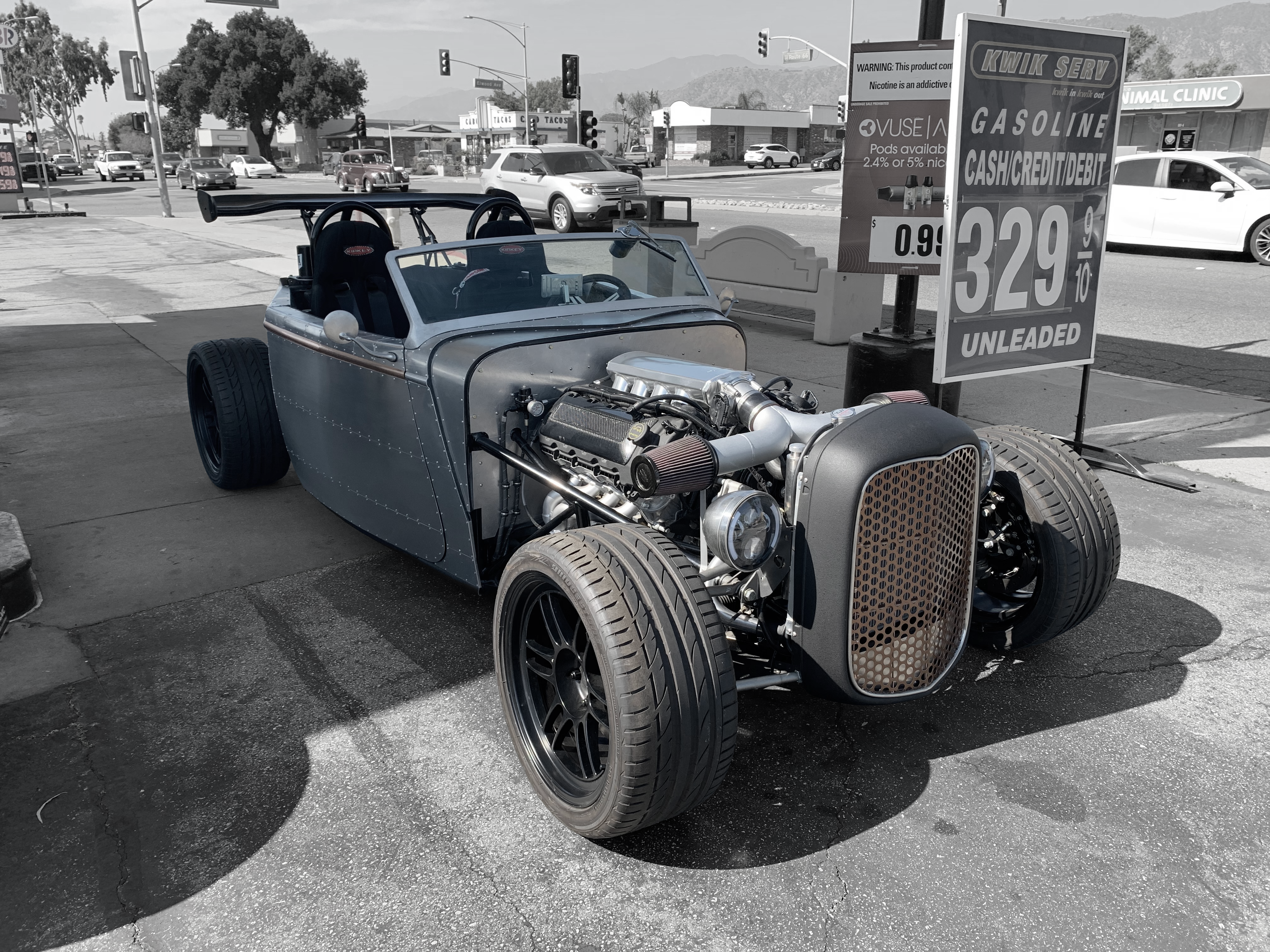
1932/33 Rat Rod Racer
A Factory Five '33 Rod kit transformed into a cross between a rat rod and a race rod — Coyote V8, TKO 600 transmission, custom aluminum body, F1-style rear wing, and nickel/copper hard lines throughout.
- Year
- 1933
- Category
- Vehicles
- Status
- Sold
- Plates
- 202
- Clips
- 15
The Vision
Starting with a modern, proven chassis a ‘32/’33 rod was turned into a raw, exposed, purpose-built machine that pairs pre-war hot rod proportions with modern race engineering. The idea is Mad Max meets pre-war F1.
The Foundation
The build started with a Factory Five Racing ‘33 Hot Rod kit — a proven tube-frame chassis designed for a Ford V8 drivetrain. The Factory Five Racing bodywork served as the basis for a ‘33 to ‘32 retro mod. From there, nearly everything was customized or upgraded beyond the kit’s original intent. Breeze Automotive control arms handle the front suspension geometry, and a Ford 8.8 rear end with a 3.55 ratio puts the power to the ground through a shortened rear axle for a tighter, more aggressive stance.
Powertrain
A Ford Coyote V8 crate engine sits exposed up front with carbon fiber engine cover, matte silver powdercoated headers and exhaust. Power routes through a Tremec TKO 600 five-speed manual transmission with an MGW short-throw shifter for precise, mechanical shifts. The Borla headers feed into a powder-coated exhaust system that exits at the rear. A Boyd aluminum fuel tank and Fuellab high-flow fuel filter keep the Coyote fed under hard acceleration.
Body & Fabrication
The body is entirely custom aluminum paneling — hand-formed and riveted to the tube frame. The front end features a custom chopped and welded ‘32 low-boy grille that sits low and aggressive. At the rear, an F1-style wing is mounted to custom welded roll hoops that double as both safety structure and aero mounting points. The raw aluminum finish against the black tube chassis is the look — no paint, no filler, just metal and fasteners.
Hard Lines & Plumbing
One of the defining details of this build is the nickel/copper hard line work running throughout the car. Brake lines are stainless steel braided with AN fittings at every connection point — no rubber, no compromises. The plumbing is as much a visual element as it is functional, with the copper lines tracing clean routes along the aluminum body panels.
Interior
The cockpit is stripped to essentials. Kirkey aluminum race seats are bolted directly to the chassis, flanking the transmission tunnel. The dashboard is a brushed aluminum panel housing Classic Instruments Moal Bomber gauges — aviation-inspired round dials with a 200 MPH speedometer front and center. The whole interior has the feel of a vintage aircraft cockpit crossed with a race car.
Wheels & Stance
Enkei RPF1 wheels in 18x9.5 — a wheel born on race tracks, not in a catalog for show cars. The RPF1 is one of the lightest forged wheels available, and on a car this light, every pound of unsprung weight matters. The wide stance and aggressive offset give the ‘33 a planted, ready-to-launch posture.